
Bulk Upload
Bulk upload adds many products at once from a spreadsheet. You can create your own new products, or sell products that are already in the store's catalog. The file is checked before anything is imported, and you get a report when it's done.
Go to Catalog >> Bulk Upload.
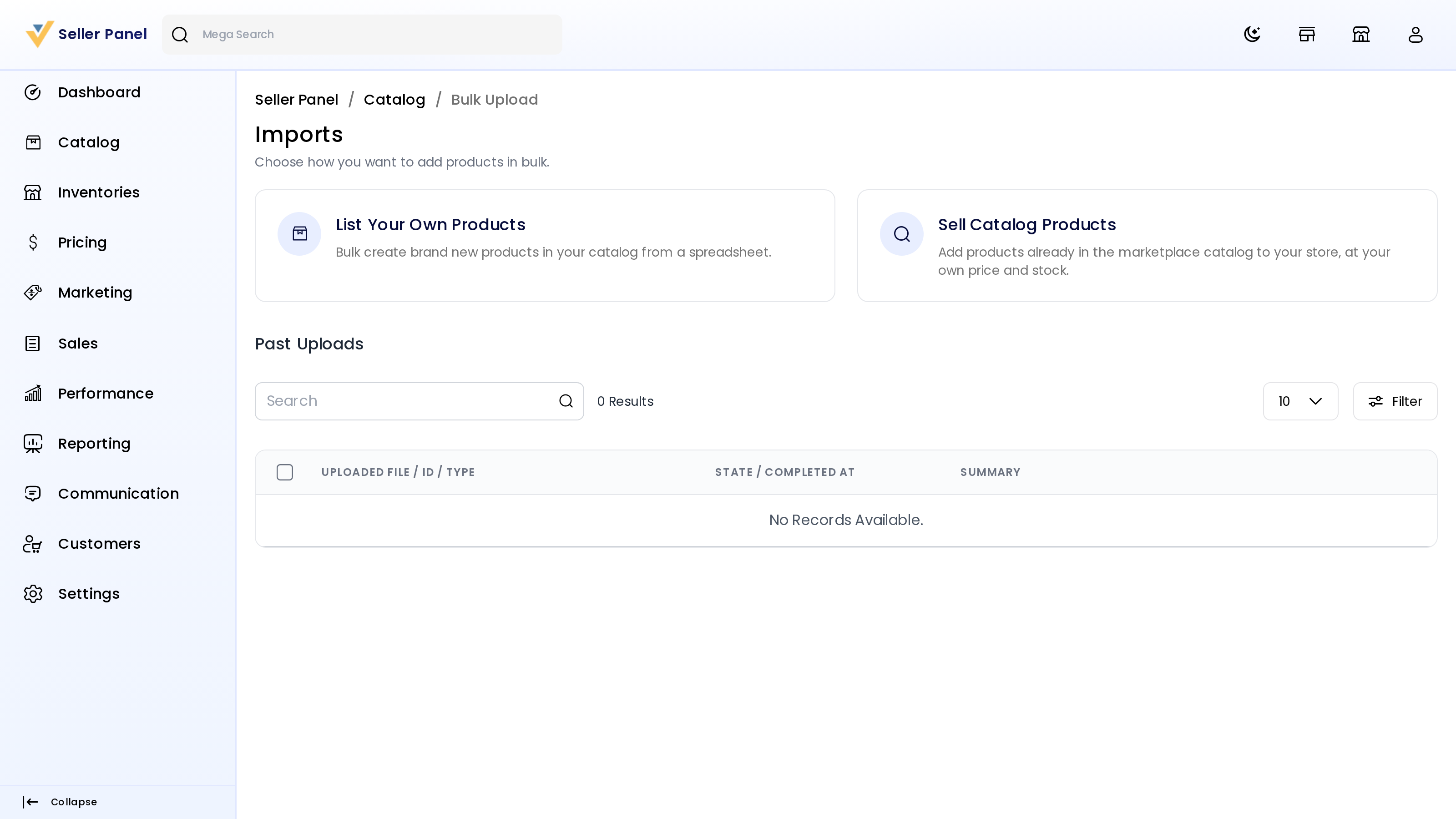
Choose what to upload
- List Your Own Products — create new products in your catalog.
- Sell Catalog Products — sell products that are already in the store's catalog, at your own price and stock.
You see an option only when the store allows it and your role includes Bulk Upload >> Imports >> Create. Your profile must be complete.
Past Uploads lists your earlier uploads with their type, state, file, completion time and a summary of what was created, updated or deleted. Use the row icons to Process, Edit, Download Report (a short summary of the run) or Delete an upload, and download the Error File when some rows failed.
Upload a file
- Go to Catalog >> Bulk Upload.
- Click List Your Own Products or Sell Catalog Products.
- In Source, under Download Sample, download the sample file in CSV, XLS, XLSX or XML.
- Fill in your products using the sample's columns, then upload it in File.
- Click Next.
- For your own products, choose in Images how the images reach the store, then click Next.
- In Settings, check the options below.
- Click Start Import, then confirm.
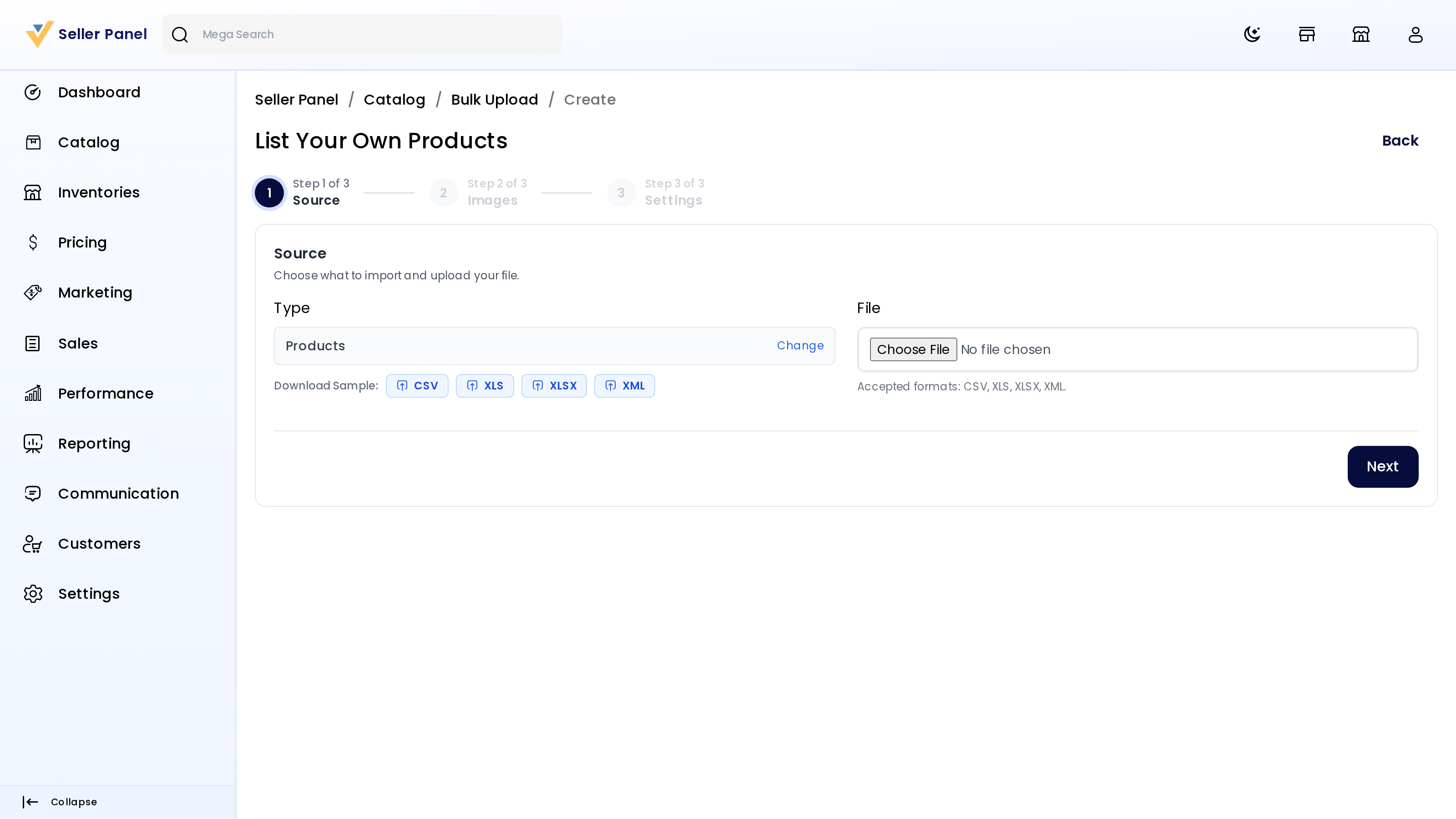
Images
- Image URLs in the sheet — add public links to the images, separated by commas, in the
imagescolumn. The store downloads them for you. This is the recommended option. - Upload a ZIP of images — put the image file names in the
imagescolumn and upload one ZIP file that contains them. The store sets the largest ZIP you can upload, 10 MB unless it has changed it.
Products you sell from the catalog use the catalog's images, so this step doesn't appear for them.
Settings
| Setting | What it does |
|---|---|
| Action | Create/Update adds new products and updates existing ones. Delete removes the products in the file. For catalog products, it removes only your offers. |
| Validation Strategy | Stop on Errors blocks the import when the file has more errors than Allowed Errors. Up to that number, the bad rows are skipped and the rest are imported. Skip Errors skips every bad row and imports the rest. |
| Allowed Errors | Used only with Stop on Errors: the most errors the file can have and still be imported. Starts at 10. |
| Field Separator | The character between columns in a CSV file, usually a comma. |
| Process in Background | Keeps the import running after you leave the page. It appears when the store can run imports in the background. |
Check and run the import
The Import page opens and checks your file straight away. When the check finishes, it shows the Total Rows Processed, Total Invalid Rows and Total Errors.
- Every row is valid — the import starts on its own.
- Some rows have errors, and your settings allow them to be skipped — the page lists the errors and says the remaining rows can still be imported. Click Start Import to import them.
- The file is invalid — fix the errors and upload the file again.
Click Download Full Report to download every error with its row.
The page shows each stage as it runs, with the progress and the number of batches completed. For your own products, the images are downloaded, the products are created, related products are linked and prices and stock are finalized. For catalog products, the offers are added to your shop.
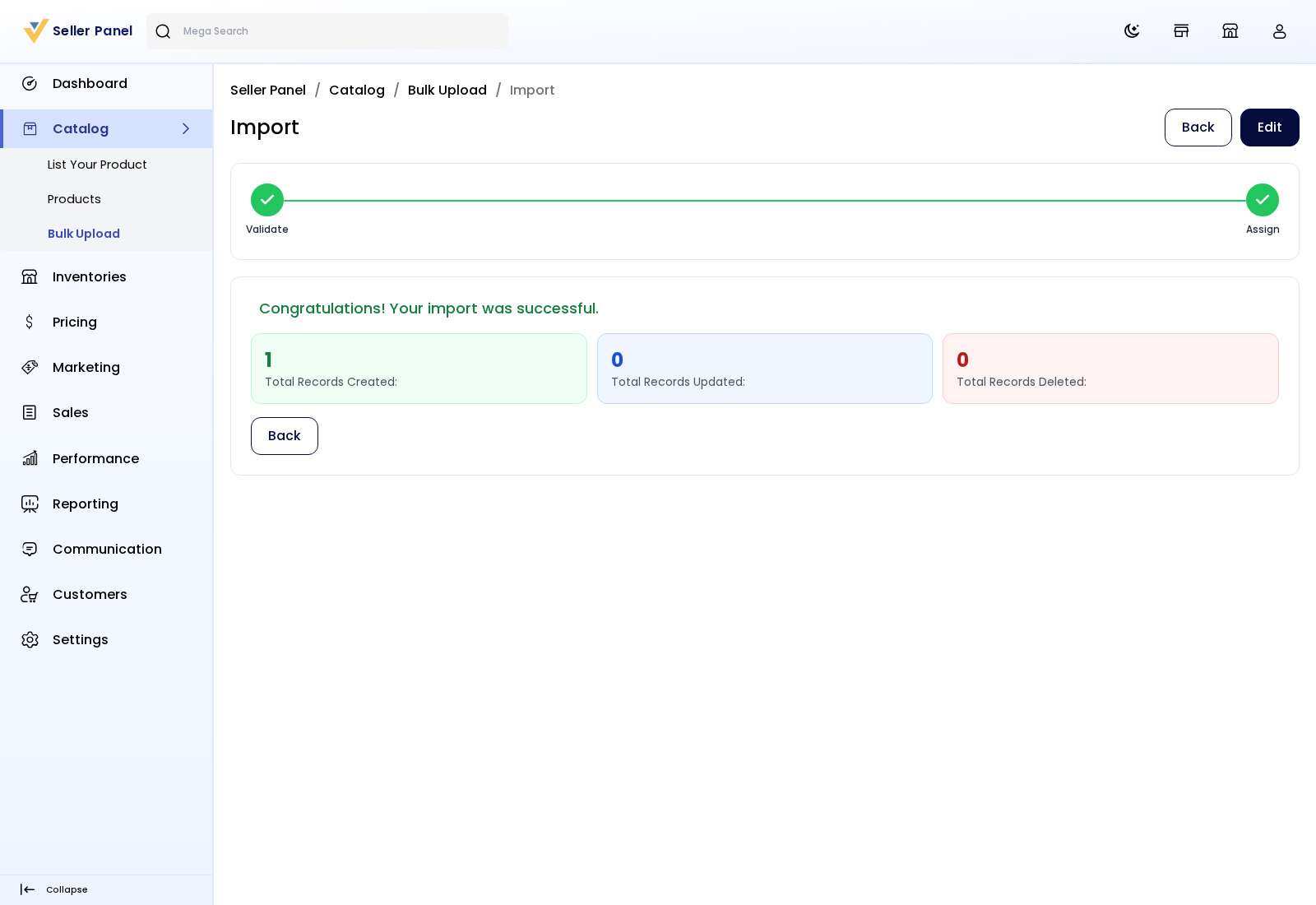
When it finishes, you'll see Congratulations! Your import was successful. with how many products were created, updated or deleted. Click Back to see them in Catalog >> Products.
New imported products follow the store's approval rules like any other product. To change a product that is already approved, edit it in the product form rather than importing it again. See Product Approval.
What goes in the file
Your own products
Start from the sample file. It has a column for each product detail, including sku, type, attribute_family_code, categories, images, name, description, price, weight, status, inventories and, for products with variations, configurable_variants.
- A SKU another seller already uses can't be imported.
- Each product type must be one you are allowed to sell.
- Downloadable products can't be imported. Create them one at a time in the product form.
- Each image link can be up to 10 MB.
Catalog products
The sheet has five columns:
| Column | What to enter |
|---|---|
sku | The catalog product's SKU. Required. |
price | Your price. Leave it empty to use the catalog price. |
qty | How many you have in stock. It goes into your first active inventory source. |
condition | new or old. Leave it empty for new. |
description | A description of your offer. Optional. |
A row fails when no catalog product has the SKU, when you already sell it, when the SKU appears twice in the file, when the store doesn't allow sellers to sell catalog products, when you aren't allowed to sell that product type, or when price, qty or condition has an invalid value.
Change or rerun an upload
Click the edit icon on an upload in Past Uploads, replace the file or change the settings, then click Reimport and confirm. The file is checked again from the start.
If the store uses subscription plans, products over your plan's limit aren't imported.