
Shipments & Carriers
Sellers ship their products by scheduling a pickup for the order. The carrier decides how the parcel travels. Self Ship is always available: the seller arranges their own courier and enters the tracking number. A courier integration can also buy labels and book collections for the seller.
Carriers are only used after an order is placed. Customers still choose from the store's shipping methods at checkout.
Schedule a pickup
- Go to Sales >> Orders.
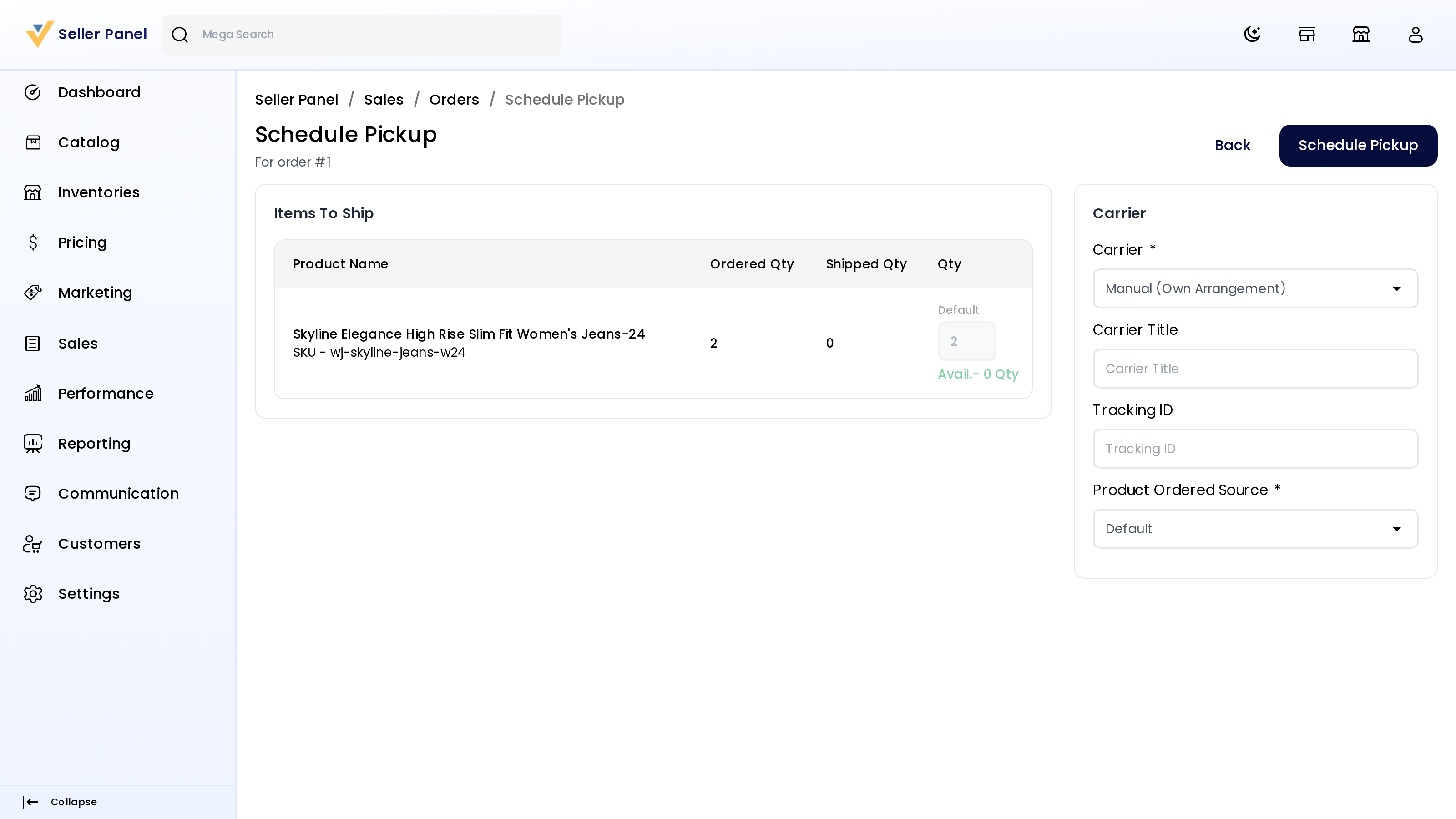
- Click Schedule Pickup on the order's row, or open the order and click Schedule Pickup.
- Choose the Product Ordered Source your products ship from.
- Under Items To Ship, enter how many of each product you are shipping from that source. Avail. shows the stock in the source.
- Choose the Carrier. For Self Ship, this is Manual (Own Arrangement), unless the store has renamed it.
- For Self Ship, you can enter the Carrier Title, such as the courier's name, and the Tracking ID.
- Click Schedule Pickup.
You'll see Shipment created successfully. The order's Shipments tab shows the carrier, the tracking number and the inventory source.
| Message | What it means |
|---|---|
| This order has nothing left to ship | Everything in your part of the order has shipped, or what's left is cancelled, refunded or has nothing to ship, such as a booking. |
| Requested quantity is not available | You entered more than is left to ship or than the source has in stock, or every quantity is 0. |
| Shipment blocked for RMA quantity: … | Shown beside a product when that much of its quantity is in a return request, whatever the request's status. That quantity can't be shipped. |
With a courier integration
When the store has installed and set up a courier integration, choosing it adds more to the page:
- Parcel — the Weight, in the store's weight unit, and the Length, Width and Height in centimetres. Each must be more than 0. A shipping label is bought when you schedule the pickup, and the tracking number is added for you.
- Collection — the Pickup Date, which can't be in the past, and either a Collection Round or the Ready At and Doors Close At times, with any Pickup Instructions for the driver, up to 500 characters.
After scheduling:
- download the label with Download on the shipment, or Print Label on the order's row;
- the shipment shows the pickup's confirmation and time window, and the Label Cost;
- shipments from the same source for the same collection time share one pickup.
The label cost is shown for your information and isn't taken from your payout.
If the courier rejects the collection window, nothing is saved; choose another time and try again. If the courier can't be booked for another reason, the shipment is still saved and marked Not Booked.
For the admin
- Set up the carriers sellers can use in Fulfilment Carriers settings.
- When you ship a seller's products from Sales >> Orders, the store's own shipment form is used, and only the seller's inventory sources are offered.
Settings and permissions
- Sellers see Schedule Pickup when Can Create Shipment is on in Sellers settings.
- Team members need Orders with Shipment.